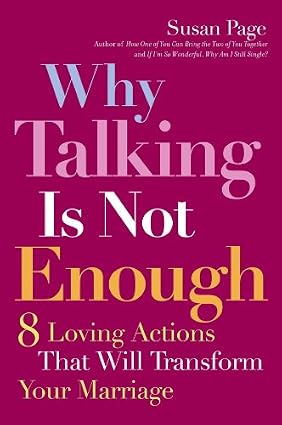
For more than four decades, Susan Page has worked with singles and couples on the practical work of loving well. In Why Talking Is Not Enough: Eight Loving Actions That Will Transform Your Marriage, she challenges the idea that communication is the only cure for a struggling relationship. We spoke with her about restraint, “acting as if,” and the single question she hopes every couple asks each day.
The Interview · Susan Page
Susan Page on Why Talking Is Not Enough
The relationship educator explains why the words we use to fix our marriages so often fail, and why eight small loving actions can do what conversation cannot.
By DORX Chronicle Editorial Desk
September 5, 2026 · 12 min read

Where the idea began
DORX Chronicle: Your book is titled Why Talking Is Not Enough. What inspired you to write it, and what did you notice about relationships that made you feel a different approach was needed?
Susan Page: It was obvious to me that using “communication” to solve problems was failing many couples. After they talk about a problem, they feel worse. Communication skills and listening don’t come naturally; they are high-level skills that most people don’t have. Often, one partner is more skilled than the other, so they are starting out on an uneven playing field. Plus, what talking is usually about is, “You need to change.”
Yet most people think there is no other alternative besides talk.
I had an incident in my own marriage that woke me up to the idea that I could make a change in myself and the problem would disappear. It worked. That led me to other strategies. I began conducting couples’ groups in which only one partner could attend. As we experimented with these slight changes in our own behaviors, miracles began to happen.
Actions over words
DORX Chronicle: You introduce the idea that loving actions can sometimes communicate more powerfully than words. What does this look like in an everyday marriage?
Susan Page: One of the first experiments we do in my groups is to make a pact with yourself that you will not say anything negative, critical, or demanding to your partner for one entire week. Plus, at least once a day, do a favor for your partner. It can even be something quiet and not noticeable.
After a week of this practice, people first reported that they had no idea how often they said negative, critical, or demanding remarks. Second, they reported that the whole atmosphere in the home was more pleasant, that they started feeling more loving, and even that their spouse seemed more attentive and sometimes even affectionate.
Some of the other loving actions can be even more powerful.
The actions couples overlook
DORX Chronicle: The book presents eight loving actions that can transform a marriage. Which do couples most often overlook, and why?
Susan Page: Some of these actions are brand new ideas. Couples have not tried them because they never thought of them. For example, I offer the option of “acting as if” you feel warm and loving, even when you don’t. When your partner annoys you again with the same awful habit, even though you feel angry, you can behave in a loving way. This can be a challenge and require practice, but the results will be transformative.
Say he comes home late again without calling. For the last ten years, you get angry every time this happens and you harp on him — how easy it would be to call, how he’s not thinking of you at all. So the same thing happens again: a frosty evening.
An alternate plan, as an experiment, is to try something different. Act as if you are happy to see him, that you are glad he’s finally home. Give him a kiss, slip him a glass of wine, ask about his day. You may find that your own mood will change also, your anger will dissipate, and he will love you for tacitly forgiving him.
The other one couples overlook is to use restraint. When you want to make a critical remark, just don’t. Stay silent. Your little jab will only bring the atmosphere in the house down, and it will not do any good.
“If you reframe it as a fact of life, your approach to it is entirely different. You don’t solve the problem; you outgrow it.”
Why fixing can push us apart
DORX Chronicle: One of your ideas encourages partners to move away from constantly trying to “fix” problems. Why can problem-solving create more distance between two people?
Susan Page: Solving problems creates distance because it highlights your differences. You are focusing on the negative aspects of your relationship and forgetting the wonderful sides. Also, some problems have no solution, so you both become frustrated.
The secret is to reframe the “problem.” If you think of it as a problem, you suppose it has a solution. If you reframe it as a fact of life, your approach to it is entirely different: How can we learn to live with this? How can we adapt? As you become more accepting, you are developing a new level of consciousness so that you don’t “solve” the problem; you outgrow it.
Loving someone, and loving them well
DORX Chronicle: You have spent many years working with couples and individuals. What has that taught you about the difference between loving someone and knowing how to love them well?
Susan Page: To love well, you need to be an advocate for your partner. Your partner’s happiness and success need to be your goal. You need to be on your partner’s side. You need to accept the whole person you are with, even the aspects of the person you like less, and have compassion for those parts. How did he or she get to be this way? The person will become the person you love fully when you create an atmosphere of love and support, not when you create an atmosphere of criticism.
Most of the people who come to my groups say, “I love him,” or “I love her, but…” — fill in the blank. If there is a but, the person is probably not loving well. That is different from saying, “We have learned how to adapt and to love all of each other.”
Responsibility without blame
DORX Chronicle: Your approach asks us to take responsibility for our own behavior rather than waiting for our partner to change. How can someone make that shift without feeling they are accepting all the blame?
Susan Page: Ahh, good question. The key is this: you are making these slight changes in behavior not for the quality of the relationship, but for yourself. Changes in the relationship will come as a by-product. Suddenly, you are taking care of yourself. You are in control — not of the relationship, but of yourself. You are no longer trying to get your partner to change or to solve a problem.
These changes in behavior have nothing to do with blame or who caused the problem. By using the loving actions, you are not accepting blame. Instead, you are accepting responsibility for making your relationship even more wonderful.
One small action to start today
DORX Chronicle: Marriage goes through periods when affection, patience, or connection feels difficult. What is one small loving action a couple can begin practicing immediately?
Susan Page: When you are feeling distant, the first thing I suggest is touch. Give your partner a hug. Say something like, “I’m feeling kind of separate and I want to feel close again. I’m sure we will get through this time.” But any of the loving actions can work to bring you closer together.
One of the principles of the loving actions is that you do them even when you don’t feel like doing them. A slight change in behavior can have an impact on your own feelings and, you hope, on the feelings of your partner. The loving actions are always done as experiments. You go into an experiment not because you know there will be a certain outcome, but because you want to find out what will happen if you try something new.
What readers should take away
DORX Chronicle: What do you hope readers understand differently about marriage after reading Why Talking Is Not Enough?
Susan Page: First, that talk is not the only tool available to you to express love, to work through issues, or to feel closer. It is slight changes in behavior that lead to changes in feelings. Also, it is vital to try something new and different. Don’t keep doing the same thing you have been doing for years and expect different results.
A moment that stayed with her
DORX Chronicle: Was there a particular experience in your work that influenced the message of this book?
Susan Page: There have been many, and I talk about many of them in the book. One that was memorable was a woman who was angry with her husband because he had bought something without consulting her. She was furious, but they were about to go to an event. She got in the car and decided not to mention it, and to act as if she was happy about going. She made a pleasant remark and acted normal, though she was still angry inside. As they began a conversation about the event, her anger began to abate.
She felt her own mood change. She never brought up the incident again. She let it go. She realized she had averted an angry argument, and that she could put the incident behind her and go on.
One thought to carry every day
DORX Chronicle: If you could leave couples with one thought from the book — something to carry into their relationship every day �� what would it be?
Susan Page: Is what I am doing or saying right now bringing us closer together or farther apart?
Official Author Credential
DORX ChronicleVerified Author
Susan Page
Relationship Educator · Bestselling Author
Author of Why Talking Is Not Enough
Scan to buy on Amazon
Point your phone camera at the code to go straight to Susan Page's book on Amazon.
View on Amazon- Credential ID
- DXC-AU-0926-SP
- Verified
- September 5, 2026
- interview
- relationships
- marriage
- nonfiction
Comments
17 comments
- Lake
One thing I learned in my own marriage is that sometimes a hug really can change the mood. There have been moments when neither of us knew what to say, but physical affection helped break the tensio
- Stephlen
There’s something about a genuine hug that can say, ‘We’re still okay,’ even when everything isn't okay ye
- Lake
Absolutely. Sometimes words make things more complicated when what you really need is a little reassurance
- Esther
I’ve definitely been guilty of the ‘I love you, but…’ feeling. It’s easy to focus so much on someone’s habits that you forget the reasons you fell in love with them in the first place
- Slogan
This is so relatable. We can become experts at noticing what's wrong and forget to notice what's still good
- Diane
My partner and I had been having the same argument for years because we kept using the same approach. Changing our behavior made more difference than another long conversation ever did
- Carolina
I used to believe every disagreement had to be resolved before going to bed. That mindset caused so many unnecessary arguments. I’ve learned that sometimes taking a break and coming back to the issue later is much healthier
- Elizabeth
One thing I learned in my own marriage is that sometimes a hug really can change the mood. There have been moments when neither of us knew what to say, but physical affection helped break the tension. 🤗❤️
- Racheal
I can relate to the example about coming home late. That used to be a huge argument in my relationship. Eventually I realized that the argument itself had become almost more damaging than the original issue
- Diane
Exactly. Sometimes you’re no longer arguing about what happened—you’re arguing about every previous time it happened too 😅
- Mariam
The ‘closer or farther apart’ question is something I wish I had learned years ago. There were times when I was so focused on proving my point that I didn’t realize I was creating more distance between us
- Tailor
Being right can sometimes feel important in the moment, but peace and connection matter more in the long run
- Avarea
I tried something similar after reading about the idea of restraint. For one week, I made a conscious effort not to make little critical comments. I was honestly surprised by how many I normally made without even noticing. 😅
- Eunice
I think that would be eye-opening for a lot of people. Those little comments can become such an automatic habit
- Laura
Same here. Sometimes it isn't the big arguments that create distance, but all the small negative remarks that build up over time.
- Avarea
I agree with you on this...x
- Anne wilson
My husband and I used to talk through the same issue over and over, and somehow every conversation ended with both of us more frustrated. Things started improving when I focused on changing how I responded instead of trying to make him understand my point.” ❤️
- Stella
“I can relate to this so much. Sometimes we think we’re communicating, but we’re really just repeating the same argument in different words
- Jane
Changing your own response can completely change the direction of an interaction
- Marvelous
I appreciate that Susan Page talks about responsibility without making it sound like one person is always to blame. That distinction matters ❤️
- Maiden
The example of the husband coming home late was very realistic. It’s amazing how one repeated situation can become a source of resentment over many years
- Emily
And sometimes the reaction becomes almost automatic. Breaking that pattern seems to be the difficult part
- Johnston
The section about restraint really resonated with me. I’ve learned that not every irritation needs to be verbalized
- Saint
Silence isn’t always avoidance; sometimes it’s choosing not to make a small problem bigger
- Snow
The question at the end is probably my biggest takeaway: “Is what I am doing or saying right now bringing us closer together or farther apart?” That’s surprisingly difficult to remember in the middle of an argument
- Ibrahim
Yes. It’s much easier to think about being right than thinking about whether we’re actually getting closer
- Alexander
I really liked the idea that talking isn’t always the solution. Sometimes the more we talk about the same problem, the more frustrated everyone becomes
- Jacob
Exactly. At some point, behavior has to change too. Words can explain a problem, but they don’t always change the atmosphere
- Daniel
I like how practical this is. Instead of giving couples another long list of things to discuss, it focuses on small behaviors they can actually try
- John
I’ve always heard that communication is the key to relationships, so the argument that talking alone isn’t enough is really interesting. Actions often say things words simply can’t.
- Maria
Sometimes we spend so much time trying to explain what’s wrong that we forget how much our everyday actions matter