

Every reader knows the feeling. Something was there all along, but suddenly you see it differently. One connection leads to another. Context changes. Expectations change. And you change. Richard Seltzer has built a whole book around that moment. His new title, Eureka! The Discovery of New Worlds: How We Think, How We Learn, How We Remember, How We Matter, was published on October 14, 2026.
At eighty, Seltzer sets out to explore a lifetime of thinking about thinking. The search leads through childhood games and imaginary worlds, chess and mathematics, stories and maps. He traces memories of love and loss, dreams, mistakes, and the strange workings of his own mind.
We are not merely inhabitants of the world we were given. Through attention, imagination, inference, memory, language, play, and relationship, we can continually discover, and create, new worlds.
The questions that multiply
Along the way, the questions multiply, and Seltzer follows each one where it leads:
- How do we learn how to learn?
- Why can two people experience the same event and remember it differently?
- What happens when we make mistakes?
- Where does meaning come from?
- What separates mind from matter?
- And what, if anything, ends when we die?
The book is, in the end, an invitation to rediscover something we knew instinctively as children: that the world is not simply handed to us finished. It is something we keep finding, and keep making.
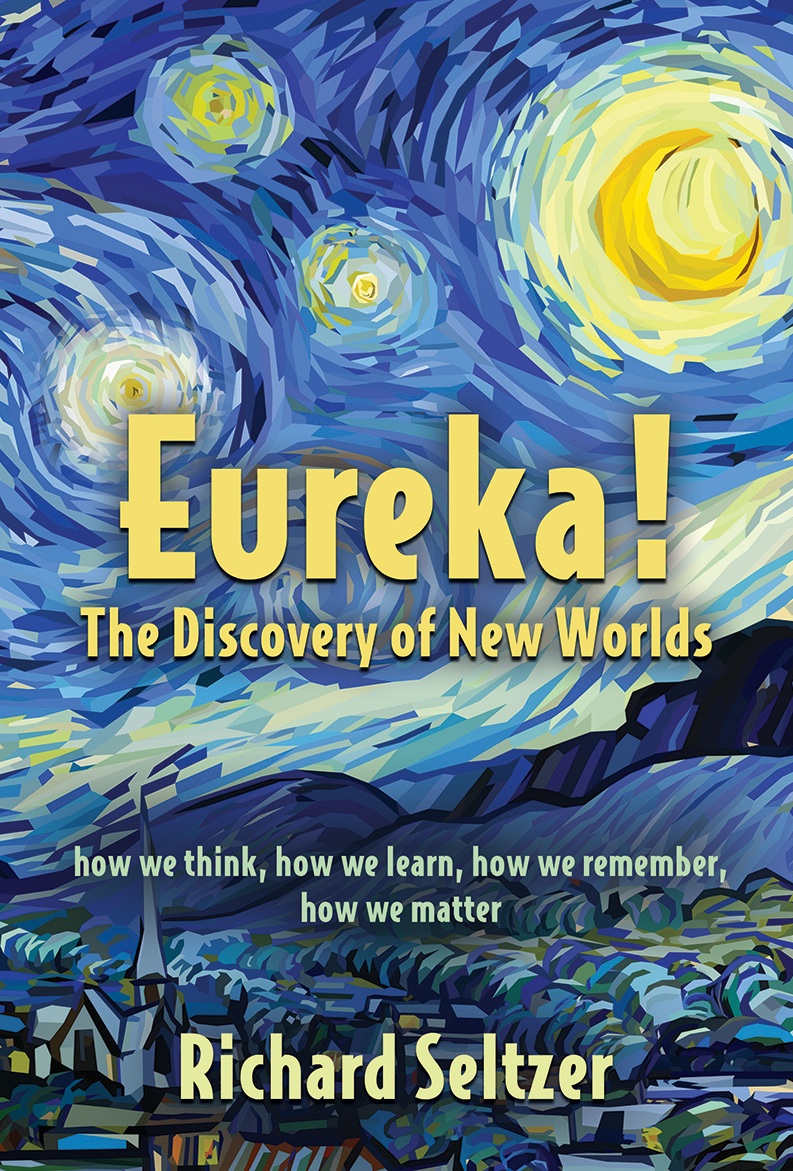
A remarkably varied shelf
Eureka! follows closely on Voices of the Owned: What They Lived Through, Remembering Slavery, which Seltzer published on Juneteenth, June 19, 2026. Now in a position to write full-time, he has produced a body of work that refuses to stay in one genre:
- Technology and life: How to Partner with AI: A New Kind of Relationship and a New Perspective on What It Means to Be Human and In Flux, non-technical looks at how technology shapes our lives.
- Family history: One Family, which blends genealogy, memoir, history, and mystery.
- The Trojan War: Breeze, We First Met in Ithaca, Trojan Tales, and Let the Women Have Their Say.
- Shakespeare: Shakespeare’s Twin Sister and We All Are Shakespeare.
- Interlocking fiction: Parallel Lives, Beyond the 4th Door, Nevermind, Breeze, Shakespeare’s Twin Sister, and To Gether Tales, which overlap and echo one another with stories inside stories and touches of magical realism and alternate history.
- And more: the historical novel The Bulatovich Saga: The Name of Hero, the story collections Meter Maid Marion and The Lizard of Oz and Other Stories, the essays of Why Knot?, Grandad Jokes, and the suspense novel Echoes from the Attic, co-written with Ethel Kaiden.
From samizdat to 14,000 ebooks
Seltzer is also the publisher of Seltzer Books, with more than 14,000 time-tested books in ebook format, sold through Barnes & Noble (Nook), Kobo, Apple, Google Play, and PublishDrive. The company began as B&R Samizdat Express: just his late wife Barbara (B) and Richard (R). Samizdat means “self-published” in Russian, a nod to his years as a Russian translator.
Before ebooks went mainstream, he published entire libraries on CD and DVD, primarily for blind readers who used screen readers to turn text into voice. One 4-DVD set held more than 20,000 books for just $149. He even made what he calls a “quixotic attempt” to build and run his own ebook store, Quench, competing single-handedly with the likes of Amazon.
The Internet evangelist
In the early days of the Web, Seltzer worked in Digital Equipment’s Internet Business Group as the company’s “Internet evangelist.” When Digital was absorbed by Compaq (itself later absorbed by Hewlett-Packard), he became an independent Internet marketing consultant and wrote extensively about business online.
His AltaVista Search Revolution was the first consumer-oriented book about search engines, and Library Journal called it “indispensable.” His Web Business Boot Camp was a pioneering guidebook for Internet start-ups. His original samizdat.com website, his sandbox for testing ideas about the Web, is preserved by the Internet Archive’s Wayback Machine in 666 captured versions from November 1996 to September 2017.
Get the book
Eureka! The Discovery of New Worlds is available now. Explore Richard Seltzer’s books, essays, and archives at seltzerbooks.com, or reach him at seltzer@seltzerbooks.com.